How False Positives Damage Legitimate Seller Relationships

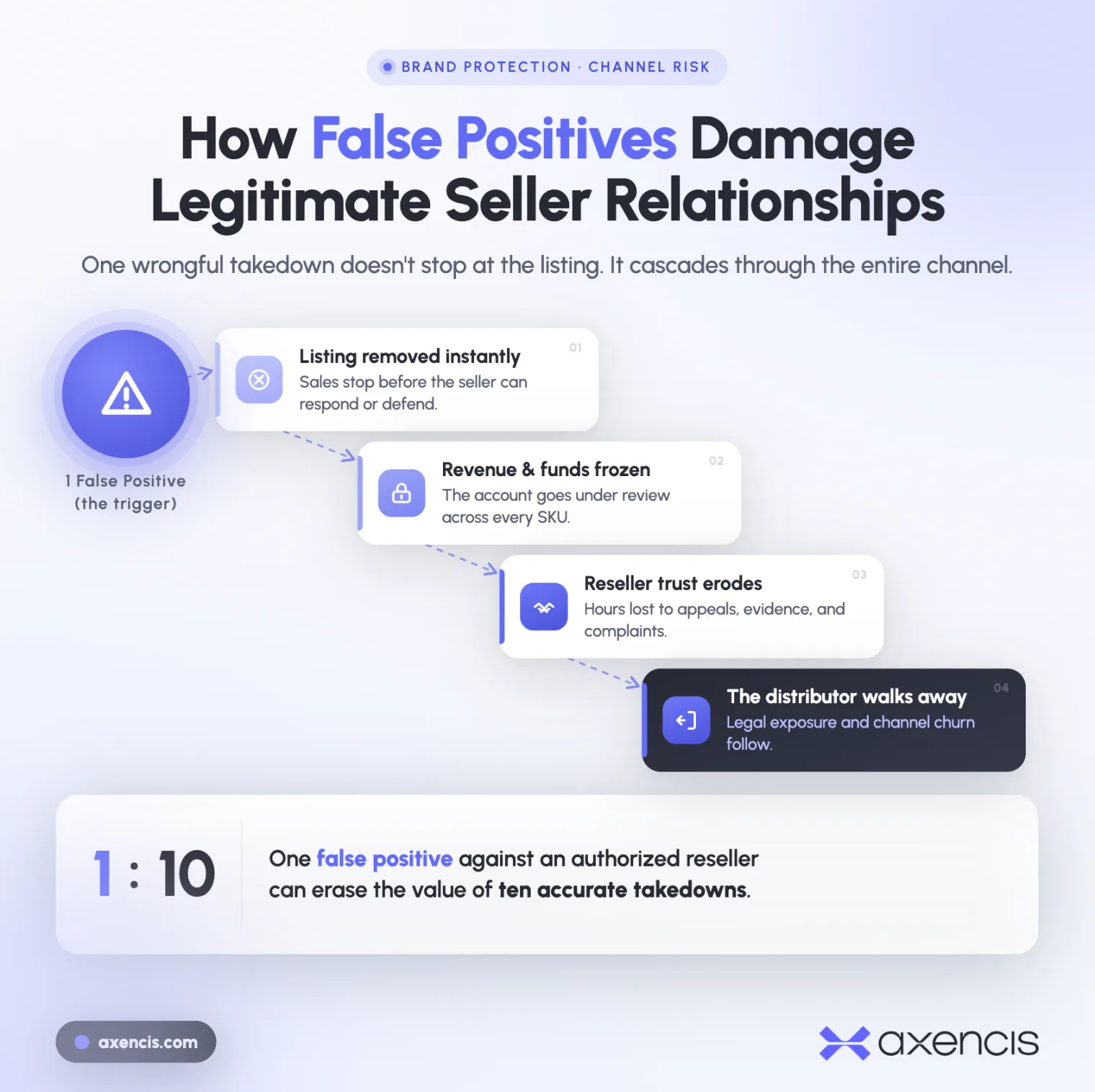
One wrongful takedown doesn’t stop at the listing. It cascades through the entire channel. Imagine it: you’ve built a strong brand, your authorised distributors are moving inventory, everything looks solid – then an enforcement provider flags what looks like a counterfeit listing and removes it. Days later your distributor calls: their legitimate inventory was taken down, their account is under review, their revenue stopped, and they’re asking whether they should keep carrying your products.
This is not hypothetical. It’s what happens when brand protection tools misfire. False positives are not a technical nuisance – they’re an operational, financial, reputational, and legal risk that cascades through channel relationships in ways takedown-volume metrics never capture. When a legitimate seller is wrongly targeted, the damage runs from immediate listing loss to frozen funds, account friction, and potential legal liability. For brands with authorised distributor networks or complex reseller ecosystems, understanding what happens when enforcement goes wrong is essential.
Annual counterfeit goods sold globally
Every takedown reviewed by a person
Of Amazon sales come from independent sellers (Reuters, 2025)
Enforcement costs covered by recovered assets
Last updated: June 2026
By: Alex Zaika, Axencis
What happens when brand protection targets a legitimate seller?
The immediate consequence is always commercial. A wrongful enforcement action removes a listing, stops sales in real time, and damages account standing before the seller has any chance to respond. What makes it especially damaging is the sequence: the action comes first, the defence comes later.
Think about what that means. Imagine a legitimate distributor with 500 active listings on Amazon and perfect account standing. One enforcement action gets it wrong: they lose that listing, their account goes under review, their other 499 listings get flagged, they lose search visibility, customers can’t find them, rankings drop. Suddenly the brand they’ve been working to support is the source of their problem.
Consider eBay, where a VeRO (Verified Rights Owner) complaint terminates auction-style and Buy It Now listings immediately. The seller must then fight to get the notice withdrawn. In UMG v. Augusto, documented by the Electronic Frontier Foundation, UMG sent repeated DMCA takedown notices to eBay sellers reselling promo CDs – lawful secondary-market activity protected by first-sale doctrine. The notices led to auction suspensions and account terminations for sellers doing nothing wrong. Courts ultimately rejected UMG’s position and upheld resale rights, but the complaint left what sellers called a “black mark” on their reputation. Immediate removal plus reputational damage means a wrongful action isn’t just a lost sale on one SKU – it damages account standing and future performance across an entire seller profile.
Amazon presents a different problem when court orders freeze seller accounts. In the Luke Combs/Nicol Harness case, Harness sold unauthorised merchandise (18 tumblers featuring Combs’ name and likeness without authorisation) for $360 in total gross revenue. The underlying infringement may have been justified, but the consequence reveals a structural problem: after a default judgment, Amazon froze $5,500 in her seller account. A $5,500 freeze on $360 in revenue is disproportionate, and for a seller on thin margins it’s devastating – it can exceed the actual harm caused. The case also drew national attention when Combs personally intervened to help. It shows why enforcement tools must be calibrated to the actual violation, not applied uniformly.
This matters because marketplace dependency is structural and growing. Reuters reported in January 2025 that more than 60% of sales on Amazon globally come from independent sellers. Walmart acknowledges the same tension: more than 500 million Marketplace items, where even a “tiny minority” of counterfeit listings can significantly hurt shoppers and honest sellers. A mistaken takedown isn’t only a compliance error. It’s a channel event – it hits your distributor network and your competitiveness in those channels.
How do false positives damage channel relationships?
The relationship damage starts with asymmetry. Your enforcement provider initiates the notice. The seller loses visibility and revenue first and argues later. They fight to get the listing back, gather evidence, hire support – and through it all they’re losing revenue and wondering whether your brand is a partner or a liability.
In UMG v. Augusto, sellers had to contact the rights owner to request withdrawal and eventually fought through litigation. In Smith v. Summit Entertainment, a creator uploaded his own song to YouTube, iTunes, CD Baby, and Amazon; Summit sent a copyright takedown notice, but the real dispute was about branding tied to the Twilight franchise, not copyright. The court found Summit’s copyright assertion was “unquestionably false.” The brand-side accusation sets the commercial penalty in motion before any court resolves the merits. That’s the dynamic that breaks trust.
Think about an authorised retailer. A false positive takes down one shoe model – isolated, until the account goes under review. Now the retailer spends 10 hours gathering evidence and writing appeals while their operations team handles customer complaints. Their advertising keeps running even though listings are unavailable, so the budget is wasted and the quarter’s targets are now unreachable. By the time the listing is restored, their enthusiasm for launching new products with your brand has cooled, and their trust in the partnership has declined. These consequences never appear on a takedown dashboard – and they’re the kind of commercial injuries that prompt sellers to sue.
Can a false takedown create legal exposure?
Yes, and the exposure is real and well documented in case law.
The clearest liability is in copyright, where the DMCA creates a specific cause of action for knowingly misrepresenting material in takedown notices. In Lenz v. Universal, the Ninth Circuit held that copyright owners must consider fair use in good faith before sending a takedown notice – a direct warning against automated or careless notice programs that don’t evaluate lawful use.
Courts have imposed monetary consequences too. In Online Policy Group v. Diebold, the court found Diebold had violated DMCA section 512(f) after sending notices over material no reasonable copyright holder could have believed was infringing, and ordered Diebold to pay $125,000 to Online Policy Group. That standard remains a reference point for wrongful-takedown liability – real financial exposure, not theory.
Even without a full damages judgment, wrongful notices can keep other claims alive. In Smith v. Summit Entertainment, the court treated the copyright assertion as “unquestionably false” and allowed claims tied to wrongful-takedown consequences, including interference and defamation theories, to proceed past motion-to-dismiss. Bad notices create litigation exposure beyond the IP theory that justified them.
In marketplace contexts, sellers can also go on offence through declaratory actions rather than waiting to be sued – converting from passive target to active litigant, and raising legal spend and reputational risk for the rights owner. Instead of regaining the revenue you lost to counterfeiters, you’re spending money defending yourself in federal court. Overreaching mass enforcement adds risk: Reuters reported in November 2024 that Chicago federal judges were pushing back against Schedule A litigation where plaintiffs hadn’t adequately argued joinder. Courts are increasingly sensitive to error, due process, and insufficiently individualised allegations. A brand that can’t show seller-specific investigation is on weaker legal ground.
How do you measure the cost of false positives?
Most enforcement teams see a removal as a “success.” But that success masks costs that sales, channel, and legal teams absorb invisibly. Until you calculate the cost of a false positive, it’s hard to understand the ROI of prevention. A simple worksheet illustrates the pattern – an example of how costs accumulate for a mid-sized seller during a 7-day false-positive incident:
Revenue impact
- Daily gross revenue affected: $4,000
- Days offline or suppressed: 7
- Total direct revenue disrupted: $28,000 (7 days x $4,000)
One-time operational & legal costs
- Margin impact: $8,400
- Internal support and account management: $1,500
- Legal review or outside counsel: $5,000
- Relationship remediation: $2,500
Total estimated cost of one false positive: $45,400, plus channel risk
For an authorised distributor with higher GMV, that number could be 5 to 10 times higher. Measuring false positives isn’t a compliance exercise – it’s a business one. The most useful KPIs to track: false-positive rate, median reinstatement time, seller revenue disrupted per false positive, number of authorised sellers incorrectly actioned, recurrence rate by seller/SKU/marketplace, legal escalations from disputed notices, and distributor churn after disputes. These convert “precision” from a qualitative promise into an operating requirement.
How does Axencis protect authorised sellers during enforcement?
The way to prevent this cascade is to build false-positive prevention into the process before action occurs. Axencis does this through mandatory human verification and authorised-seller controls at every step, part of a wider human-verified brand protection approach.
The foundation is a current authorised-seller registry – storefront names, legal entities, distributor relationships, territories, escalation contacts. The point isn’t only to whitelist approved sellers, but to stop matching systems treating ambiguity as infringement. This follows directly from case law: eBay’s NOCI process is treated as a good-faith assertion, not conclusive proof, and courts have imposed duties of good-faith analysis before notices go out.
Every flagged listing receives a human analyst review before enforcement. Analysts check product images, seller history, pricing patterns, and authorised-distributor records before acting. That distinguishes counterfeits from unauthorised genuine products, authorised sellers with localised branding, and legitimate resale. High-risk cases get mandatory escalation: sellers matching an authorised-reseller profile, appearing to sell genuine goods, with long account history, or representing meaningful channel revenue go through additional review gates. Automation can rank risk; human judgement should be the final arbiter of partner legitimacy.
Most infringing listings are removed within 48 hours after human verification for platform takedowns, and major marketplaces process verified submissions within 24-72 hours. Legal enforcement timelines such as Schedule A cases follow different procedural tracks and operate on court schedules. When removals fail or a seller disputes an action, clients receive documented explanations on request – visibility into platform responses rather than summary metrics, which creates a defensible record and preserves goodwill if escalation occurs.
Axencis vs automation-heavy enforcement: how do they differ?
| Factor | Automation-heavy | Axencis human-verified |
|---|---|---|
| Verification | AI detection, human-in-the-loop on significant decisions only | Every flagged listing gets human review before takedown |
| Authorised seller protection | Detection logic may not account for authorised resellers | Checked against authorised-distributor database; explicit false-positive prevention |
| Removal speed | Variable; sometimes slower than desired | 48-hour target; 24-72 hours after verification |
| Evidence discipline | Same product + lower price treated as counterfeit | Distinguishes counterfeits, gray market, territorial leakage, warranty divergence |
| Seller communication | Summary metrics and removal count | Named contact, specific evidence, clear deadline, documented explanations |
| Legal risk | Overbroad enforcement attracts judicial scrutiny | Seller-specific investigation creates a defensible record |
| False-positive cost | Relationship damage, legal escalation, distributor churn | Prevention through pre-action verification |
The key insight: the cost of one false positive against an authorised reseller often exceeds the value of ten accurate takedowns on unauthorised sellers. When you do the maths, precision isn’t a feature. It’s a requirement.
Key takeaways
- A wrongful takedown is a channel event, not a one-SKU error – it freezes accounts, wastes ad spend, and erodes distributor trust.
- The seller loses first and argues later – that asymmetry is what breaks the relationship.
- False takedowns carry real legal exposure – DMCA 512(f) liability (Diebold, $125k), declaratory actions, and judicial pushback on overbroad enforcement.
- Measure beyond takedown volume – false-positive rate, reinstatement time, revenue disrupted, distributor churn.
- Human verification before action is the prevention – one false positive can cost more than ten accurate takedowns.
Frequently asked questions
What is a false positive in brand protection enforcement?
A false positive is a wrongful enforcement action against a legitimate seller – taking down listings sold by authorised resellers, legitimate gray-market sellers, or sellers with genuine products, when the system misidentifies them as counterfeit or unauthorised.
How does a false positive damage brand relationships?
False positives create asymmetric risk: the brand initiates enforcement, the seller loses revenue first and argues later. A wrongly targeted distributor spends time gathering evidence, writing appeals, and managing customer complaints, wastes its ad spend, and loses trust in future joint programmes. The relationship damage often exceeds the value of correct takedowns.
Can a brand be sued for a false takedown?
Yes. In copyright cases, courts impose liability under DMCA section 512(f) for knowing misrepresentation – Online Policy Group v. Diebold resulted in a $125,000 judgment. In trademark cases, sellers can file declaratory actions, creating litigation risk. Courts are increasingly pushing back against overbroad mass enforcement without seller-specific investigation.
How can a brand prevent false positives during enforcement?
Maintain an authorised-seller registry, require human review before removing sellers matching authorised profiles, use evidence discipline to distinguish counterfeits from gray-market sales, establish a seller-communication protocol with named contacts and clear deadlines, and run a root-cause review on every confirmed false positive.
What should a brand measure to evaluate enforcement precision?
Beyond takedown volume: false-positive rate, median reinstatement time, seller revenue disrupted per false positive, number of authorised sellers incorrectly actioned, legal escalations from disputes, and distributor churn. These reveal whether enforcement strengthens channel control or damages it.
Sources
- Electronic Frontier Foundation – DMCA & takedown case law (Lenz v. Universal, Online Policy Group v. Diebold, UMG v. Augusto)
- Reuters – Amazon independent-seller share (Jan 2025) and Schedule A litigation coverage (Nov 2024)
- Axios – Walmart Marketplace seller-vetting and counterfeit controls (2025)
- U.S. Copyright Office – DMCA section 512 (misrepresentation liability)
Is your enforcement protecting your channel, or damaging it?
Axencis runs human-verified enforcement that prevents false positives without slowing takedowns – so your authorised distributors stay protected and every removal is defensible. Legal enforcement runs on the Performance Partnership model, with costs covered by recovered assets.