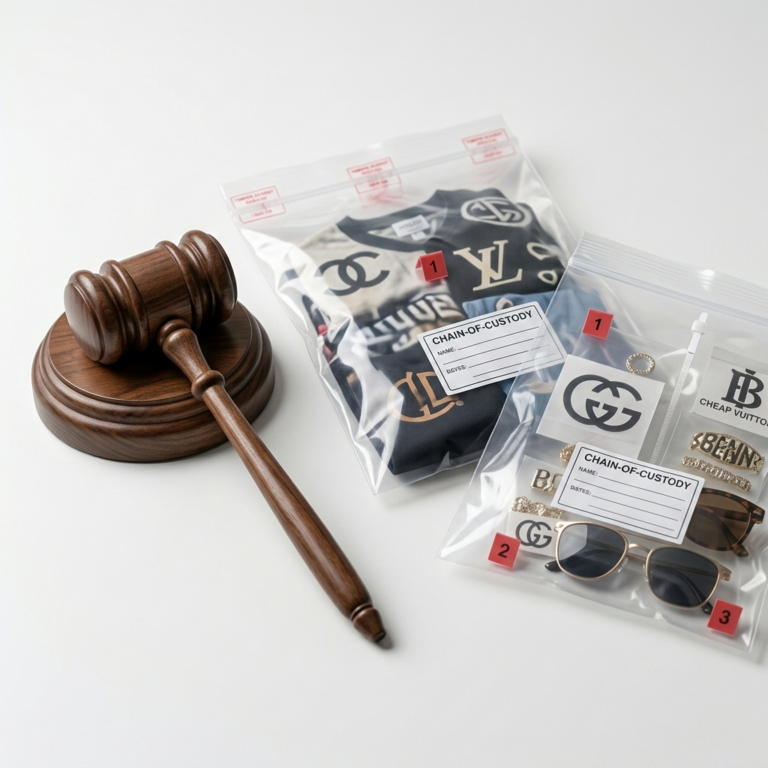
Trademark attorneys charge $300-$600 per hour, and a single cease and desist letter costs $1,500-$3,000. Meanwhile, counterfeit listings stay live for weeks while that letter works its way through the mail. Brands spend thousands monthly on legal fees to fight online counterfeits, but the traditional legal path wasn’t built for how counterfeiting actually works in 2026. Fake products spread across Amazon, eBay, social media, and standalone websites at a pace that courtroom procedures can’t match. The question isn’t whether you need protection – it’s whether lawyers or specialized platforms deliver better results for the money.
Annual counterfeit goods sold globally
Every takedown reviewed by a person
Platform-based enforcement vs weeks for legal letters
Costs covered by recovered assets
Last updated: March 2026
By: Alex Zaika, Axencis
Why does the traditional legal approach fall short for online counterfeits?
Hiring a trademark attorney feels like the obvious move when someone’s copying your products. And for certain situations, it absolutely is. But when you’re dealing with online counterfeits popping up across multiple marketplaces and social platforms? The legal path creates more friction than it resolves.
Here’s the core problem: legal processes were designed for courtrooms, not for Amazon’s Brand Registry or Instagram’s IP reporting system. Lawyers draft formal letters, prepare thorough documentation, and build cases for potential litigation. That’s exactly what you want when you’re headed to court. It’s exactly wrong when a counterfeit listing is racking up sales right now.
The cost stacks up fast. At $300-$600 per hour, even basic enforcement gets expensive. A single cease and desist letter runs $1,500-$3,000. If you’re facing 50 new infringing listings per month – which isn’t unusual for mid-market brands – you’re looking at $100,000-$150,000 in monthly legal fees before any actual litigation begins. That math doesn’t work for most companies.
Speed is the other killer. Formal cease and desist letters typically take 2-4 weeks to get a response. During that entire period, counterfeit products remain available to your customers. Every day those listings stay active is a day your brand reputation takes hits and your authorized distributors lose sales.
Then there’s the anonymous seller problem. Many counterfeiters operate through fake identities or from jurisdictions where legal threats carry zero weight. They simply ignore your attorney’s letter and open a new seller account. Your $2,500 cease and desist just became an expensive piece of paper.
What do brand protection platforms do differently?
Specialized brand protection platforms attack online infringement from the opposite direction. Instead of legal procedures aimed at courtrooms, they work directly within marketplace enforcement systems – Amazon Brand Registry, eBay’s VeRO program, social media IP reporting channels – where counterfeits actually get removed.
Speed changes everything. Most platform-based enforcements complete within 24-48 hours. That’s days versus weeks. Direct relationships with marketplace enforcement teams mean priority attention and faster processing. While a lawyer is still drafting a cease and desist, a platform has already identified the listing, documented the infringement, submitted the report through the right channel, and gotten the listing removed.
Pricing works differently too. Platforms typically charge fixed monthly fees based on coverage scope – no surprise hourly billing, no cost escalation as infringement volumes increase. For small to mid-size brands, that’s usually $2,000-$10,000 per month including monitoring, detection, validation, and enforcement. Compare that to legal representation where you pay separately for every single action.
The biggest difference? Platforms think in networks, not individual cases. They identify patterns linking seller accounts, track repeat offenders across marketplaces, and coordinate enforcement to disrupt entire counterfeit operations. A lawyer pursues one infringer at a time. A platform maps the whole operation and hits it from multiple angles simultaneously.
Teams at these platforms often include former marketplace personnel and policy experts who understand operational realities from the inside. That institutional knowledge matters when you’re navigating Amazon’s specific requirements versus Alibaba’s versus social commerce platforms.
How do lawyers and platforms actually compare?
The differences become clearest in a direct side-by-side comparison. Here’s how the three main approaches stack up across the metrics that matter most to brands making this decision.
| Dimension | Traditional Legal | Brand Protection Platform | Hybrid Approach |
|---|---|---|---|
| Cost structure | $300-$600/hr. $5K-$10K/mo retainer | $2K-$10K/mo fixed fee | Platform fee + legal retainer for strategic work |
| Speed to removal | 2-4 weeks (cease and desist cycle) | 24-48 hours (direct platform enforcement) | 24-48 hours for operational, weeks for legal escalation |
| Platform expertise | Limited. Trained for courtrooms, not marketplaces | Deep. Former marketplace staff and policy specialists | Platform handles operational, lawyers handle formal proceedings |
| False positive risk | Low (manual review), but slow and expensive | Varies. Automated systems: 15-25%. Human-verified: <2% | Depends on platform selection |
| Best for | Complex litigation, trademark strategy, UDRP disputes | Operational enforcement, marketplace takedowns, seller network disruption | Brands needing both daily enforcement and periodic legal action |
| Scalability | Poor. Costs scale linearly with volume | Strong. Fixed fees cover increasing enforcement | Good. Platform absorbs volume, legal handles exceptions |
| Monthly cost range | $5,000-$10,000+ (before litigation) | $2,000-$10,000 | $4,000-$15,000 |
| Litigation cost per infringer | $50,000-$100,000+ | N/A (handles pre-litigation only) | Platform resolves 90%+, legal handles the rest |
The pattern is clear. For the daily grind of online enforcement – detecting, documenting, and removing counterfeit listings across marketplaces – platforms deliver faster results at lower cost. Lawyers win on strategic IP work and formal proceedings, but that’s a small percentage of what most brands actually need.
I think the biggest mistake brands make is treating this as an either/or decision when it doesn’t have to be. More on that in a moment.
When does legal representation still make sense?
Lawyers aren’t the wrong choice for brand protection. They’re the wrong choice for operational online enforcement. That’s an important distinction.
Legal representation remains the right move for specific situations that platforms can’t handle.
Complex litigation with significant damages. When infringement has caused measurable harm worth pursuing through the courts, and potential damages recovery justifies the legal investment, you need an attorney. A platform can’t file a lawsuit.
Trademark strategy and portfolio management. Registering trademarks internationally, navigating opposition proceedings, building IP strategies across multiple jurisdictions – this requires genuine legal expertise. No platform replaces a good trademark attorney for strategic IP work.
Negotiated settlements and licensing. When you want ongoing licensing revenue or structured settlements rather than simple takedowns, legal representation is essential. These negotiations require legal authority and contractual expertise.
Formal legal proceedings. Domain disputes requiring UDRP, cases needing discovery and depositions, or matters requiring courtroom representation. These are inherently legal processes.
How do the costs actually compare?
Let’s put real numbers on this, because the cost differences are where most brands start paying attention.
Legal-only approach: Attorney retainers for ongoing brand protection typically start at $5,000-$10,000 per month for modest coverage. That’s before any litigation. Pursuing a single infringer through the courts can cost $50,000-$100,000 or more. And hourly rates of $300-$600 mean every phone call, every email review, every document draft adds to the bill. Facing 50 new listings monthly? You’re potentially looking at $100,000-$150,000 in legal fees alone.
Platform-only approach: Monthly fees typically range from $2,000-$10,000 for small to mid-size brands. That flat fee covers monitoring, detection, validation, and enforcement across multiple marketplaces. No per-action charges. No surprise billing when infringement volumes spike. The predictability alone is worth something to finance teams.
Hybrid approach: This is what most sophisticated brands end up choosing. A platform handles the operational work – daily monitoring, detection, and enforcement – while legal counsel stays on retainer for strategic matters, complex cases, and formal proceedings. Total cost typically runs $4,000-$15,000 per month, but you’re getting better coverage than either approach alone.
Here’s the thing most brands don’t calculate: cost per successful enforcement. A platform removing a listing in 24 hours for effectively $40-$100 per action (based on monthly fee divided by enforcement volume) versus a lawyer spending 5-10 hours at $400/hr to send a cease and desist that might get ignored. The unit economics aren’t close.
How does Axencis combine platform speed with expert oversight?
Most brand protection platforms trade accuracy for speed. They automate detection and enforcement to move fast, but automated systems generate false positive rates of 15-25%. That means legitimate sellers get caught in the crossfire – authorized resellers, parallel importers, second-hand dealers who aren’t doing anything wrong.
The Trustpilot ratings for major platforms tell this story clearly. Competitors in this space average 1.5-1.9 stars, with complaints consistently mentioning AI-driven false positives targeting legitimate sellers.
Axencis takes a different approach. Every enforcement decision involves human review by analysts trained in trademark law and brand protection. The technology handles monitoring and detection across marketplaces, social media, websites, and apps. But a person validates every takedown before it’s submitted.
False positive rate below 2%. That’s not a marketing number – it’s a function of having humans check the work. You don’t waste time and credibility resolving disputes with legitimate sellers who were wrongly targeted.
Enforcement success rate exceeding 95%. Well-documented claims that platforms trust. When your reports are consistently accurate, marketplace enforcement teams process them faster and approve them at higher rates.
Transparent operations. Real-time dashboard visibility into all enforcement actions. You see what’s happening, when it’s happening, and what results it’s producing. No black box.
The Performance Partnership model means Axencis’s costs are covered by recovered assets from infringers. That alignment matters – when the provider only wins if you win, the incentives point in the same direction.
How should you decide between lawyers and platforms?
Brand protection requires specialized expertise that general practice attorneys don’t have. Understanding marketplace policies, platform enforcement systems, and seller network patterns demands years of focused experience that law firms rarely develop. Your IP attorney can secure your trademarks brilliantly and still be the wrong choice for stopping counterfeits on Amazon.
Start by asking what you actually need right now. If you’re dealing with active counterfeit listings across multiple platforms and you want them removed quickly, a specialized platform is the right tool. If you’re building your trademark portfolio or preparing for formal legal action against a specific infringer, you need a lawyer.
Most brands discover they need both – just for different things. Platforms handle the 90%+ of enforcement that’s operational. Lawyers handle the strategic and formal work that requires legal authority. Trying to use lawyers for everything is like hiring an architect to hang pictures. They could do it, but it’s expensive overkill for the task.
Trust specialists for online protection. The brands that get this right aren’t choosing between lawyers and platforms. They’re using each where it actually makes sense.
Key takeaways
- Lawyers and platforms solve different problems – Legal representation excels at strategic IP work and formal proceedings, while platforms handle operational online enforcement faster and cheaper.
- Speed kills counterfeits, not paperwork – Platform-based enforcement removes listings in 24-48 hours. Cease and desist letters take 2-4 weeks, and counterfeiters often ignore them entirely.
- The cost gap is massive at scale – Facing 50 monthly infringements? Legal fees could reach $100,000-$150,000. Platform fees stay fixed at $2,000-$10,000 regardless of volume.
- False positives are the hidden risk – Automated platforms average 15-25% false positive rates. Human-verified enforcement keeps that below 2%, protecting your credibility with marketplaces.
- The hybrid approach wins for most brands – Use platforms for daily operational enforcement, keep legal counsel for strategic matters. Better coverage, lower total cost.
Frequently asked questions
Should I use a lawyer or a platform for brand protection?
It depends on what type of enforcement you need. For operational online enforcement – removing counterfeit listings from Amazon, eBay, social media, and other marketplaces – a specialized platform delivers faster results at lower cost. For strategic IP work like trademark registration, portfolio management, litigation, and formal legal proceedings, you need a lawyer. Most brands benefit from using both for their respective strengths.
How much do brand protection platforms cost?
Monthly fees typically range from $2,000-$10,000 for small to mid-size brands. This usually includes monitoring, detection, validation, and enforcement across multiple marketplaces. Unlike legal representation where you pay $300-$600 per hour for every action, platform fees are fixed regardless of how many enforcement actions are taken in a given month.
When should I hire a trademark attorney instead of using a platform?
Hire a trademark attorney for complex litigation with significant damages, trademark registration and portfolio management, negotiated settlements and licensing agreements, domain disputes requiring UDRP, and any matter requiring courtroom representation. These are inherently legal processes that platforms can’t handle. Don’t hire an attorney for routine marketplace enforcement – that’s not what they’re built for.
Can I use both a lawyer and a brand protection platform?
Yes, and that’s what most sophisticated brands end up doing. The platform handles daily operational enforcement – monitoring, detection, and takedowns across marketplaces and social media. Legal counsel stays available for strategic IP matters, formal proceedings, and complex cases. This hybrid approach typically costs $4,000-$15,000 per month but provides better coverage than either approach alone.
How fast can brand protection platforms remove counterfeit listings?
Most platform-based enforcements complete within 24-48 hours through direct marketplace relationships and established reporting channels. Compare that to traditional legal approaches where cease and desist letters take 2-4 weeks to get responses – if they get responses at all. Platforms work within marketplace enforcement systems directly rather than sending external legal correspondence.
What are false positives in brand protection, and why do they matter?
False positives occur when enforcement systems incorrectly flag legitimate sellers as counterfeiters. This targets authorized resellers, parallel importers, or second-hand dealers who aren’t infringing. Fully automated platforms generate false positive rates of 15-25%, damaging relationships with marketplaces and legitimate business partners. Human-verified services like Axencis maintain false positive rates below 2% by reviewing every enforcement decision before submission.
Why don’t cease and desist letters work against online counterfeiters?
Many online counterfeiters operate anonymously or through jurisdictions where legal threats carry no weight. They ignore cease and desist letters and simply open new seller accounts. The letters also take 2-4 weeks to process, during which counterfeit listings remain active and selling. Marketplace-based enforcement bypasses the infringer entirely by working with the platform to remove the listing directly.
How much does it cost to pursue a single counterfeiter through litigation?
Pursuing a single infringer through formal litigation typically costs $50,000-$100,000 or more, depending on complexity, jurisdiction, and whether the case goes to trial. For brands facing dozens or hundreds of counterfeit sellers, litigation against each one is financially impossible. That’s why platforms handle the volume enforcement while legal action is reserved for the highest-impact cases where damages recovery justifies the investment.
Sources
- OECD/EUIPO – Trade in Counterfeit and Pirated Goods: Mapping the Economic Impact
- Amazon Brand Protection Report 2024 – 15 million counterfeit goods seized
- Business Research Insights – Brand Protection Software Market Report (2024-2033)
- Straits Research – Global Brand Protection Market Size ($2.67B in 2024)
- American Bar Association – Intellectual Property Law Section (attorney fee benchmarks)
Spending thousands on legal fees while counterfeit listings stay live?
Axencis removes counterfeit listings in 24-48 hours through direct platform enforcement – with human review on every decision to keep false positives below 2%. Find out how platform-based protection compares to your current legal spend.
About the author
Alex Zaika is part of the team at Axencis, specializing in brand protection strategy and enforcement operations for enterprise brands. Alex’s analysis draws on direct experience helping organizations evaluate and transition between legal and platform-based protection models. For questions about which approach fits your brand, get in touch.